


Quick Overview:Taj Mahal Quartzite is a natural metamorphic quartzite sourced from Brazilian mines, widely adopted in commercial and residential decoration projects for stable physical properties and consistent veining performance.
With Mohs hardness around 7 and compressive strength typically above 180 MPa, it is widely specified for kitchen countertops, feature walls, bathroom vanities, and hospitality interiors.
Compared with marble, Taj Mahal Quartzite provides higher scratch resistance and better acid resistance while maintaining a softer visual texture suitable for contemporary luxury interiors. The material is frequently used in large-format slab projects requiring both visual consistency and long-term durability.
1.Geological Composition and Physical Properties
Taj Mahal Quartzite is formed through metamorphic recrystallization of sandstone under high pressure and temperature. Its quartz content usually exceeds 90%, resulting in higher density and hardness than calcite-based marble materials.
Technical Specifications
| Property | Taj Mahal Quartzite | Typical Marble |
| Mohs Hardness | 6.5–7 | 3–4 |
| Water Absorption | ≤0.5% | 0.5–2% |
| Compressive Strength | 180–250 MPa | 70–140 MPa |
| Heat Resistance | High | Medium |
| Acid Resistance | Moderate–High | Low |
| Surface Porosity | Low | Medium |
| UV Stability | Good | Moderate |
Why These Parameters Matter
- Lower water absorption reduces staining risk in kitchen applications.
- Higher hardness improves scratch resistance in high-use surfaces.
- Better thermal stability allows installation near cooktops and fireplaces.
- Lower porosity simplifies daily maintenance requirements.
For commercial interiors, these characteristics reduce long-term maintenance costs compared with softer calcite-based stones.
2. Why Taj Mahal Quartzite Became Popular in Interior Design
2.1 Neutral Color Structure Compatible With Multiple Design Styles
Most Taj Mahal Quartzite slabs feature:
- Warm beige background
- Soft grey or taupe veining
- Low visual contrast
- Consistent directional flow
This color structure works with:
- Oak cabinetry
- Walnut veneers
- Bronze metal finishes
- Matte black fixtures
- Warm concrete textures
Unlike high-contrast marble materials, Taj Mahal Quartzite creates lower visual fatigue in large-scale interior applications.
2.2 Large Slab Compatibility for Seamless Design
Modern residential and hospitality projects increasingly require:
- Full-height wall cladding
- Waterfall islands
- Continuous backsplash systems
- Integrated vanity surfaces
Taj Mahal Quartzite is commonly available in slabs exceeding:
Standard Slab:2800–3200 mm
Jumbo Slab:3200–3600 mm
Thickness:18 mm / 20 mm / 30 mm
This allows fewer seams in oversized installations.
2.3 Lower Maintenance Compared With Marble
Calcite-based marble is vulnerable to etching caused by:
Lemon juice
Vinegar
Wine
Acidic cleaners
Quartzite surfaces show significantly better resistance due to quartz mineral composition.
Maintenance Comparison
| Maintenance Factor | Taj Mahal Quartzite | Marble |
| Acid Etching Risk | Low | High |
| Scratch Resistance | High | Medium |
| Sealing Frequency | 12–24 months | 6–12 months |
| Daily Cleaning Difficulty | Low | Medium |
For luxury residential kitchens and hotel suites, reduced maintenance is a major procurement factor.
3.Common Applications of Taj Mahal Quartzite

Kitchen Countertops
Taj Mahal Quartzite is frequently specified for:
Waterfall islands
Countertops
Full-height backsplashes
Integrated dining extensions
Engineering Advantages
| Requirement | Performance |
| Heat Resistance | Suitable near cooktops |
| Scratch Resistance | Suitable for daily kitchen use |
| Structural Stability | Good for long-span islands |
| Seam Visibility | Low with directional veining |
Recommended thickness:
20 mm for standard countertops
30 mm for large islands and commercial projects
Bathroom Vanity Tops
The material performs well in wet environments due to low absorption rates.
Typical applications include:
Floating vanities
Integrated sinks
Shower feature walls
Bathtub surrounds
For hotel projects, honed finish is commonly selected to reduce visible water marks.


Fireplace Surrounds
Quartzite's thermal resistance makes it suitable for fireplace cladding and hearth applications.
Common Fabrication Details
| Fabrication Type | Application |
| Bookmatched Panels | Feature fireplace walls |
| Mitred Edges | Minimalist surrounds |
| Fluted Surface Processing | Contemporary detailing |
Large-format slabs reduce joint lines around fireplace openings.
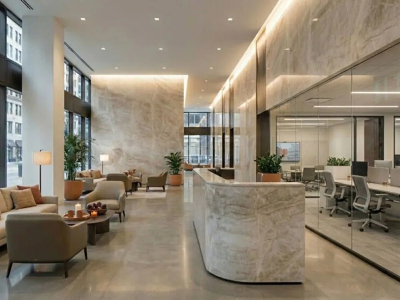
Commercial and Hospitality Projects
Taj Mahal Quartzite is increasingly used in:
Luxury hotels
Retail showrooms
Branded residences
Corporate lobbies
High-end restaurants
Reasons include:
Neutral color compatibility
Lower replacement frequency
Better durability than marble
Premium appearance without excessive pattern variation
4. Fabrication Considerations
Although durable, Taj Mahal Quartzite requires specialized tooling due to its hardness.
Processing Recommendations
| Fabrication Stage | Recommendation |
| Cutting | Diamond bridge saw |
| Edge Profiling | CNC processing |
| Sink Cutouts | Waterjet recommended |
| Surface Finish | Polished or honed |
| Transportation | A-frame packing with foam separation |
Improper tooling may cause:
Edge chipping
Blade overheating
Surface vibration cracks
Experienced quartzite fabricators generally use slower feed rates compared with marble processing.
5. Common Surface Finishes
Polished Finish
Characteristics:
- Higher light reflectivity
- Enhanced vein visibility
- Easier surface cleaning
Applications:
- Kitchen countertops
- Vanity tops
- Feature walls
Honed Finish
Characteristics:
- Lower reflectivity
- Softer tactile texture
- Reduced fingerprint visibility
Applications:
- Bathroom surfaces
- Commercial interiors
- Contemporary minimalist projects
6.B2B Procurement & Customization Advantages
As a factory direct supply stone, Taj Mahal Quartzite has prominent cost and service advantages for wholesalers, contractors and designers. Longton Stone supports full-link B2B customized services to match different project bidding requirements.
- Size Customization: Support standard slab (2400*1200mm, 3000*1500mm) and non-standard special-sized cutting, mesh-mounted processing for rapid on-site installation
- Surface Treatment: Provide polished, honed, leathered and brushed surface finishes to meet different design style needs
Conclusion
Taj Mahal Quartzite remains one of the most specified quartzite materials in contemporary interiors because it combines:
- Mohs hardness around 7
- Low water absorption
- Neutral architectural color tones
- High compatibility with modern interior materials
- Better durability than marble in high-use environments
Its balance between visual softness and structural performance makes it suitable for both residential and commercial applications requiring long-term material stability.
For wholesalers, contractors, and design studios, Taj Mahal Quartzite continues to be a low-risk material choice for premium projects.