


Quick Summary:Natural stone including marble, quartzite, granite, and luxury exotic slabs features unique natural veining, color variations, and inherent texture differences that no industrial manufacturing can replicate. While this natural uniqueness is what makes stone a top choice for high-end villa renovations, hotel lobby cladding, custom kitchen islands, and feature wall projects, it also brings unavoidable challenges for global stone buyers, contractors, and interior designers. Uneven color matching, disjointed vein patterns, inconsistent slab specifications, and hidden surface defects often lead to rework, project delays, and unexpected cost losses after on-site installation. This is where dry-lay inspection becomes an indispensable quality control step in professional natural stone production and export. As a core pre-shipment inspection process for high-grade stone projects, dry-lay testing allows manufacturers to arrange, splice, and check all finished stone slabs in advance before packaging and shipping. In this guide, we will fully explain what dry-lay inspection is, why it matters for your stone projects, and how this strict quality procedure helps you avoid common natural stone installation risks and ensure perfect on-site finishing results.
What Is Dry-Lay Inspection and Why Does It Matter?

Dry-Lay Inspection for 18–30 mm Slabs and Cut-to-Size Stone
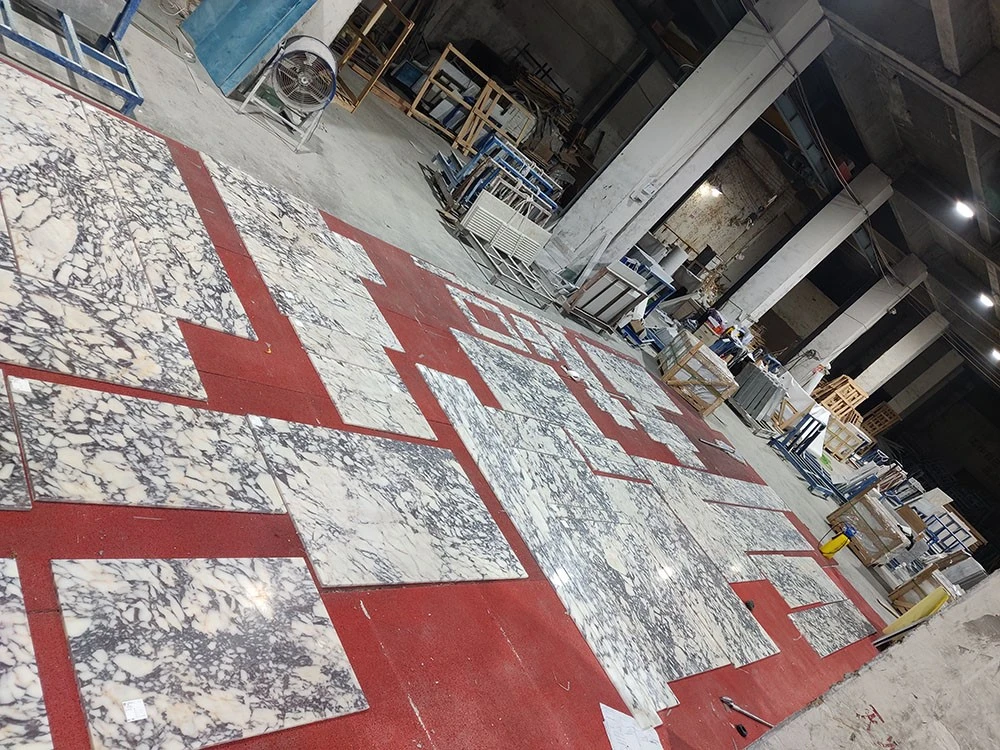
Dry-lay inspection means placing stone pieces on a flat surface without permanent installation to simulate their final arrangement.
It is especially useful for natural stone with significant variation between slabs. Unlike engineered materials with relatively controlled patterns, marble, quartzite, granite, limestone, and other natural stones can vary from one slab to another in background color, mineral concentration, veining, and surface movement.
For B2B orders, dry-lay inspection is not simply a visual presentation. It is a production check performed before packing.
A typical inspection can verify:
- Color consistency across slabs from the same order
- Vein direction and pattern flow
- Bookmatched layout for adjacent slabs
- Panel sequence according to installation drawings
- Cutting dimensions against approved drawings
- Surface defects such as cracks, chips, scratches, or resin marks
- Edge condition after CNC processing
- Thickness consistency according to the agreed specification
For example, if a project requires 20 mm marble panels for a feature wall, the factory can arrange the finished pieces in their intended sequence before packing. This gives the buyer an opportunity to identify a visually unsuitable combination before the shipment reaches the installation site.
Why Is Dry-Lay More Important for Natural Stone Than Uniform Materials?
Natural Stone Variation Requires Physical Slab Inspection
Natural stone is formed through geological processes, so variation is part of the material itself. Two slabs from the same block may have similar characteristics but will rarely have identical patterns.
| Inspection Item | What Dry-Lay Checks | Why It Matters |
|---|---|---|
| Background color | Light/dark variation | Prevents unsuitable color grouping |
| Vein direction | Horizontal, vertical, diagonal movement | Controls visual continuity |
| Pattern density | Concentrated or open areas | Helps balance large surfaces |
| Bookmatch | Mirrored vein relationship | Required for symmetrical layouts |
| Surface condition | Cracks, scratches, resin marks | Reduces installation defects |
| Dimensions | Length, width, diagonals | Confirms fabrication accuracy |
| Edge condition | Chips, profile consistency | Affects visible joints |
A small stone sample can show the general color and texture, but it cannot represent the complete variation of a 2.8 × 1.6 m or larger slab.
This is why physical slab selection becomes more important as the project area increases.
How Dry-Lay Solves Color Variation and Vein-Matching Problems
Color and Vein Control Across Large-Format 20–30 mm Slabs
One of the most common problems in natural stone procurement is not a defective slab but an unsuitable combination of individually acceptable slabs.
A single slab may pass inspection, while placing it next to another slab creates an unwanted contrast in color or pattern.
Dry-lay inspection allows the production team to evaluate the complete group together.
Controlling Natural Color Variation
Natural stone may contain differences in:Green or gray intensity,White background density,Mineral concentration,Vein thickness,Clouding,Crystal distribution,Resin-filled areas
For commercial projects with large quantities, slabs can be grouped according to their visual characteristics before cutting or packing.
The purpose is not to eliminate natural variation. It is to control where the variation appears within the finished project.
For example:
Similar tones → Main feature area
Moderate variation → Secondary surfaces
Strong pattern variation → Selected decorative areas
This approach is particularly useful for hotels, villas, retail spaces, and commercial interiors where several stone surfaces are visible from the same viewpoint.
Bookmatched Layout for High-Vein Marble and Quartzite
Bookmatched Layout Based on Vein Direction and Slab Sequence
For heavily veined marble and quartzite, bookmatching can turn two separate slabs into one continuous visual composition.
The slabs are arranged so the natural pattern mirrors across the central joint.
| Layout Method | Slab Arrangement | Typical Application |
|---|---|---|
| Standard layout | Same direction | Floors, walls, countertops |
| Bookmatched | Mirrored pattern | Feature walls, fireplaces |
| Vein matched | Continuous direction | Islands, counters |
| Cross-matched | Pattern changes direction | Decorative feature surfaces |
| Sequential layout | Planned slab order | Large commercial walls |
Before cutting, the factory can determine where important veins will appear relative to:Sink cutouts,Cooktop openings,Electrical outlets,Door openings,Wall joints,Countertop seams,Edge profiles.
This reduces the chance of cutting through a visually important section of the stone.

LongTon's 100% Dry-Lay Factory QC Standard
100% Dry-Lay Inspection Before Export Packing
For projects requiring controlled stone layouts, LongTon uses a 100% dry-lay inspection standard before shipment. The purpose is to check the finished stone pieces as a complete group rather than inspecting each piece only as an isolated product.
The inspection can cover the relationship between individual pieces, including color, pattern direction, dimensions, and intended sequence.
The process generally follows:
Production → Initial QC → Dry-Lay → Pattern & Dimension Check → Final QC → Packing → Shipment
This approach is particularly relevant to fabricated stone products where several individual components form one finished installation.
Examples include:
20–30 mm marble feature walls
20–30 mm quartzite kitchen islands
Custom bathroom vanity sets
Integrated stone sinks
Reception counters
Fireplace surrounds
Stone dining tables
Large-format wall panels
Infrared Detection During Factory Inspection
Infrared Detection for Non-Contact Surface and Process Checking
Where infrared inspection equipment is used within the factory QC process, it can provide non-contact information by identifying differences in surface temperature or thermal response.
It should not be treated as a replacement for visual inspection, dimensional measurement, or laboratory testing.
For natural stone production, different inspection methods address different risks:
| QC Method | Main Purpose | Suitable Inspection Stage |
|---|---|---|
| Visual inspection | Color, veins, scratches, visible defects | Slab & finished product |
| Dimensional measurement | Length, width, thickness, diagonals | Fabrication |
| Dry-lay inspection | Pattern sequence and visual continuity | Before packing |
| Edge inspection | Profile and edge condition | Finished product |
| Infrared detection | Non-contact thermal/process checking where applicable | Factory QC |
| Final packing inspection | Protection and quantity | Before loading |
The actual inspection method should be matched to the stone type and product specification. Infrared detection does not replace physical measurement or visual QC.
Dry-Lay Inspection for Different Stone Applications
20–30 mm Countertops, Islands, Walls, and Furniture
The inspection method changes according to how the stone will be installed.
Kitchen Islands
For a large kitchen island, the inspection should consider the relationship between the countertop and waterfall sides.
The layout should account for:
- Slab direction
- Waterfall edge position
- Sink and cooktop cutouts
- Seam location
- Edge profiles
- Visible front-side pattern
Feature Walls
For a feature wall, the main concern is often the overall pattern across multiple slabs.
A dry-lay layout can establish:
- Left-to-right slab sequence
- Central vein position
- Bookmatched arrangement
- Joint locations
- Door or opening positions
- Panel numbering
Stone Furniture
For dining tables, coffee tables, reception counters, and similar products, the inspection focuses on the relationship between the tabletop, edges, legs, and other stone components.
This is important when a single design uses several pieces cut from the same slab.
What Should B2B Buyers Request Before Shipment?
Physical Samples, Slab Photos, and Dry-Lay Records for Bulk Orders
A professional natural stone supplier dry-lay process should give buyers enough information to approve the material before shipment.
For a commercial order, buyers should consider requesting:
- Current slab photographs
- Full-slab videos where available
- Dry-lay photographs
- Bookmatched layout images
- Approved cutting drawings
- Piece numbering
- Final dimensions
- Surface-finish confirmation
- Packing photographs
- Loading photographs
For large orders, it is useful to keep the approved dry-lay record with the project documentation. This provides a reference for production and installation teams.
Why Dry-Lay Inspection Matters for International B2B Projects
Export QC, Fumigated Wooden Bundles, and Pre-Shipment Approval
When stone is shipped internationally, correcting a visual layout problem after delivery can be expensive.
The buyer may need to deal with:
- Additional local fabrication
- Re-cutting
- Replacement material
- Installation delays
- Additional labor
- Additional freight
- Project schedule changes
Dry-lay inspection moves part of this quality check to the factory before the stone is packed.
After approval, the finished stone can be protected using fumigated wooden bundles, reinforced crates, foam protection, corner protection, and other agreed export-packing measures.
For international shipments, wooden packaging should comply with applicable ISPM 15 requirements.
LongTon Stone: Factory QC Before Shipment
100% Dry-Lay Inspection and Export-Ready Packing
LongTon Stone supplies natural stone slabs and fabricated stone products for international distributors, contractors, architects, and project buyers.
For orders where pattern control is required, the production workflow can include:
- Material selection
- Slab inspection
- Production according to approved drawings
- CNC processing or CNC waterjet cutting
- Surface and edge finishing
- 100% dry-lay inspection
- Final dimensional and surface inspection
- Protective packing
- Fumigated wooden bundle packing
- Export loading
For high-movement marble, quartzite, and other decorative stones, this process helps connect the approved slab appearance with the final fabricated product.
You can also review our latest [Project News] to see examples of stone applications, fabrication, and completed project work.
Request a Factory Dry-Lay Video
Factory-Recorded Dry-Lay Videos for Pre-Shipment Review
For overseas buyers, visiting a Chinese stone factory before every order is not practical. A factory-recorded video can provide a direct view of the material and production status.
For applicable orders, buyers can request video records showing:
Full stone slabs
Dry-lay arrangement
Vein direction
Bookmatched layout
Fabricated edges
Surface finish
Product dimensions
Final packaging
This is especially useful for high-value marble, quartzite, translucent quartzite, and custom stone furniture, where the actual material appearance is an important part of the purchase decision.
Request a factory dry-lay video before shipment to review your stone layout, pattern sequence, and finished products.
Dry-Lay Inspection Checklist for Stone Procurement
20–30 mm Slabs and Custom Fabrication QC Checklist
Before approving a bulk order, procurement teams can check:
Material: Confirm the approved stone type and actual slab selection.
Color: Compare adjacent slabs rather than evaluating each slab independently.
Pattern: Confirm vein direction and pattern density.
Layout: Verify bookmatched or sequential arrangement.
Dimensions: Check finished sizes against approved drawings.
Finish: Confirm polished, honed, leathered, or other specified finish.
Edges: Check profiles, corners, and visible edge conditions.
Cutouts: Confirm sink, cooktop, outlet, and other openings.
Packing: Verify protective materials and fumigated wooden bundles.
Documentation: Keep dry-lay photos and approved drawings with the order record.
The more expensive and pattern-sensitive the stone, the more useful a documented dry-lay inspection becomes.
Conclusion
Dry-lay inspection is a practical factory quality-control step for natural stone orders. It allows the manufacturer and buyer to review color variation, vein direction, bookmatched layouts, dimensions, surface condition, and piece sequence before the material is shipped.
For B2B buyers, the main benefit is control. Instead of discovering an unsuitable stone arrangement after a container arrives, the layout can be reviewed at the factory while production and replacement options are still available.
LongTon's 100% dry-lay inspection standard is designed to provide this additional checkpoint before export packing. For a bulk marble, quartzite, stone furniture, or architectural stone order, request a factory dry-lay video and production photos before shipment to verify the actual material and finished products.