


Introduction:Perla Venata Quartzite is a Brazilian natural quartzite known for its cream-to-beige background and fine white, ivory, and gray veining. With its quartz-rich composition, low water absorption, and high hardness, it is suitable for commercial interiors, hospitality projects, countertops, feature walls, flooring, stairs, and custom stone furniture.
For architects, contractors, and stone distributors, the selection of Perla Venata Quartzite should go beyond color. Slab size, vein direction, thickness, surface finish, batch consistency, fabrication requirements, and dry-lay inspection all affect the final result. This guide covers the key material characteristics, design applications, backlighting considerations, fabrication options, and procurement points to help B2B buyers evaluate Perla Venata Quartzite slabs for real projects.
Perla Venata Quartzite, also known in the international stone market as Taj Mahal Quartzite, is a Brazilian natural quartzite recognized for its cream-to-beige background and fine white, ivory, gray, or warm-toned veining.
In recent years, Perla Venata Quartzite / Taj Mahal Quartzite has become increasingly popular in the U.S. and Australian natural stone markets, particularly for residential and hospitality projects requiring the appearance of light marble with the physical characteristics of quartzite. Its applications include countertops, kitchen islands, feature walls, hotel reception areas, flooring, stairs, bathroom vanities, and custom stone furniture.
For architects, contractors, distributors, and stone importers, material selection should not be based on the trade name alone. Actual slab color, vein direction, slab size, thickness, finish, batch consistency, and fabrication requirements should be reviewed before bulk purchasing.
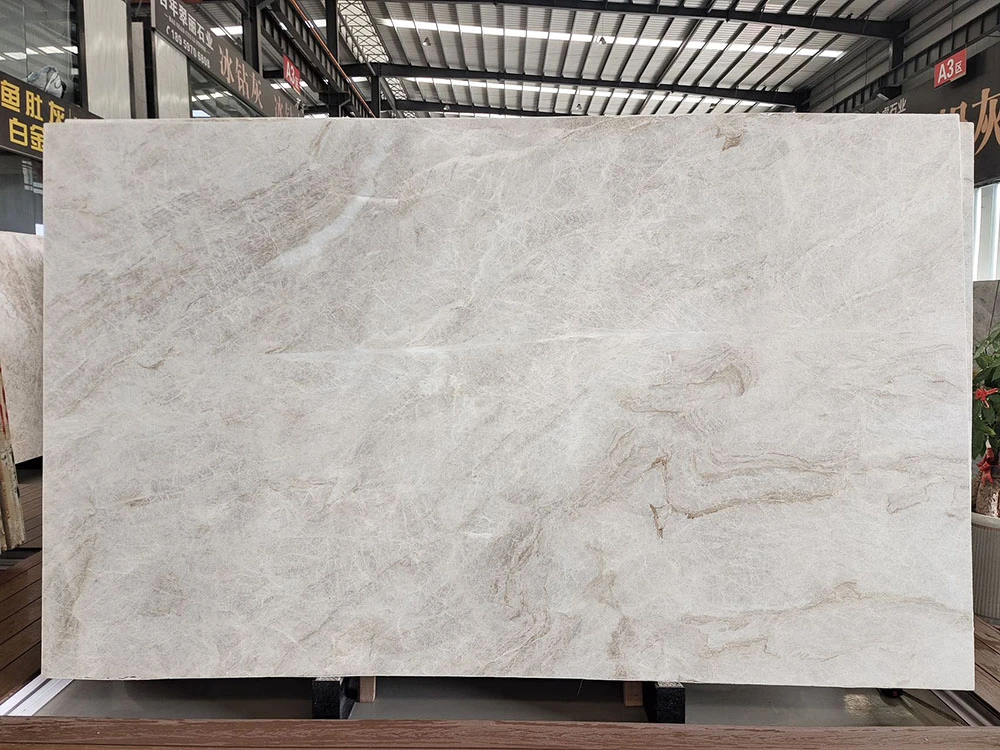
Perla Venata Quartzite: Material Definition and Slab Characteristics
Perla Venata is quarried in Brazil, including production areas in Ceará. Geological references describe Perla Venata and related light-colored quartzites from the Médio Coreaú region as quartzites formed from metamorphosed sedimentary material.
Commercially, Perla Venata is generally supplied as large-format slabs in 18mm,20 mm and 30 mm thicknesses, with polished, honed, leathered, and other finishes available depending on the quarry and processing line.
The visual structure is relatively controlled compared with heavily patterned exotic quartzites. The background normally ranges from creamy white and ivory to beige or taupe, while the veins can appear gray, white, cream, or light champagne. Natural variation between blocks and slabs should therefore be expected.
18–30 mm Slab Specifications for Commercial Procurement
| Item | Typical Perla Venata Specification |
|---|---|
| Stone type | Natural quartzite |
| Origin | Brazil |
| Typical color | Cream, ivory, beige, taupe |
| Typical thickness | 18mm/20 mm / 30 mm |
| Common finishes | Polished, honed, leathered, brushed |
| Typical applications | Countertops, walls, flooring, stairs, tables, hospitality interiors |
| Density | Approx. 2,630–2,700 kg/m³ |
| Water absorption | Approx. 0.10–0.30% |
| Uniaxial compressive strength | Approx. 154.7 MPa in one published technical sheet |
| 3-point bending strength | Approx. 20.3 MPa in one published technical sheet |
Published technical data varies according to quarry, batch, test method, and specimen. One Brazilian technical sheet reports 0.15% water absorption, 2,630 kg/m³ apparent density and 154.71 MPa uniaxial compression strength, while other commercial references report a broader 0.10–0.30% absorption range. Project specifications should therefore be based on the actual batch test report rather than a generic catalogue value.
Vein Direction and Bookmatched Layout for Large Projects
For architects and stone contractors, the main design issue is not simply the color of Perla Venata. It is how the vein structure is carried from one slab to the next.
Large wall panels, reception counters, elevator surrounds, islands, and feature walls should be planned from the actual slab photographs before CNC cutting. When several slabs are required, the purchasing team should request full-slab images showing the complete surface rather than relying only on small samples.
Bookmatched layout is particularly useful where the natural vein direction is strong enough to create a continuous mirrored composition. For large commercial walls, slab numbering should be established before fabrication so that the fabricator knows the intended sequence.
A practical procurement workflow is:
Block selection → slab production → slab photography → slab numbering → dry-lay inspection → CNC/waterjet fabrication → final inspection → export packing.
This reduces the risk of receiving slabs that are individually acceptable but unsuitable for the planned wall or floor layout when placed togeth
Perla Venata Quartzite in Hotel Reception and Commercial Interiors
Perla Venata works well in hospitality interiors where the design requires a light natural-stone surface without the stronger contrast found in many dark or highly veined stones.
A hotel reception desk can use Perla Venata for the front cladding, countertop, side panels, and matching feature wall. The stone can also be fabricated into reception counters, concierge desks, elevator surrounds, fireplace surrounds, bathroom vanities, and decorative wall panels.
For high-traffic commercial projects, the stone specification should distinguish between surface appearance and engineering requirements. A polished finish may be selected for reception counters and decorative walls, while honed or leathered finishes can be considered where reduced surface reflection is preferred.
For projects requiring large quantities, ask the supplier to confirm:
slab thickness and dimensional tolerance;
available slab sizes;
block or batch consistency;
surface finish;
resin treatment, if applicable;
vein direction and bookmatch sequence;
inspection photographs before shipment;
export packing method.
B2B Procurement: Slab Selection Before Fabrication
For distributors, contractors, and hotel projects, the most useful pre-order document is not a single product photograph. It is a current inventory sheet showing slab numbers, dimensions, thickness, finish, and full-slab photographs.
Request the latest Perla Venata Quartzite slab inventory and bulk quotation from our China stone factory before confirming your project quantity.
This allows the buyer to select slabs according to the actual project layout rather than purchasing against a generic product image.

Perla Venata Quartzite Wall Panels and Feature Walls
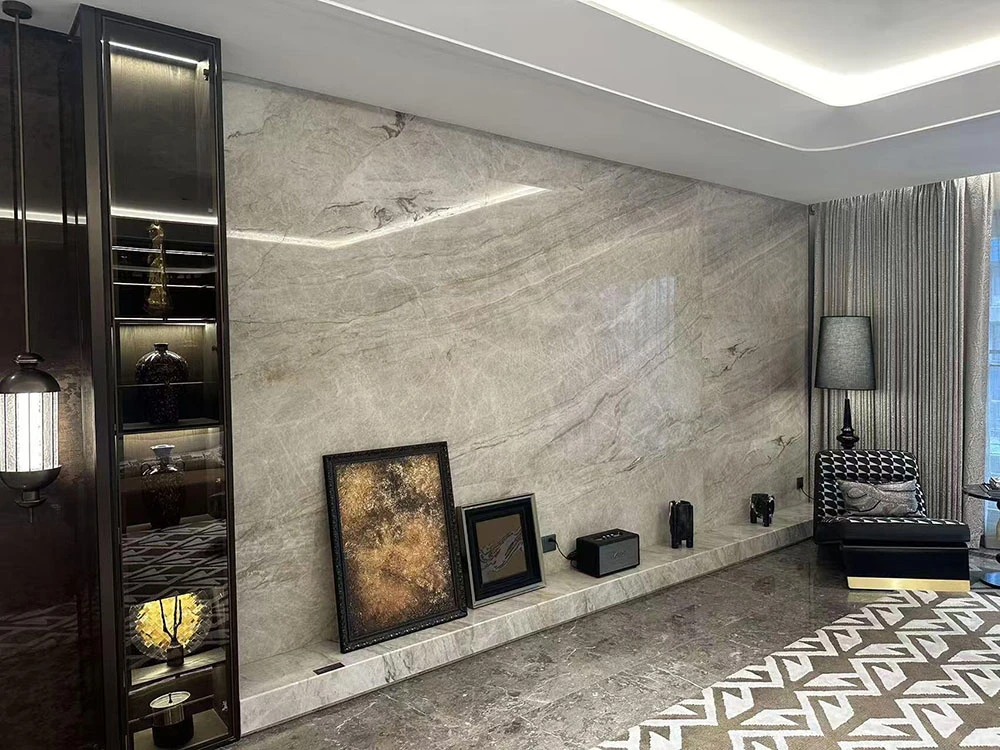
Perla Venata is suitable for interior wall cladding, feature walls, hotel lobby backgrounds, fireplace surrounds, elevator areas, and decorative architectural panels. Commercial stone references list interior walls and flooring among its established applications.
For a hotel lobby, the stone can be installed as large-format wall panels with controlled joint positions. Where the project uses several adjacent slabs, bookmatched or vein-matched layout can be specified to maintain continuity across the wall.
The wall system should be designed separately from the stone itself. Panel thickness, substrate, mechanical fixing, adhesive selection, joint width, panel dimensions, and site conditions should be confirmed by the project engineer or installer.
For high-visibility walls, a dry-lay inspection before installation is recommended. This allows the installation team to check color variation, vein direction, resin marks, edge condition, and slab sequence before adhesive or mechanical fixing is applied.
Perla Venata Quartzite Countertops, Tables and Furniture
Perla Venata can be fabricated into kitchen countertops, islands, bathroom vanities, dining tables, coffee tables, reception desks, and other stone furniture. Commercial suppliers commonly offer 20 mm and 30 mm slabs for these applications.
For furniture production, the slab selection process is different from standard wall cladding. The visible surface area of a table or countertop may use a large central section of one slab, so vein placement should be checked before cutting.
For OEM stone furniture production, the fabrication package can include:
Slab selection → CNC cutting → edge profiling → waterjet cutting → sink/cooktop cut-outs → polishing → dry assembly → final QC → fumigated wooden packaging.
This approach is suitable for buyers purchasing finished stone tables, reception counters, vanity tops, or custom furniture components from a China stone manufacturer.

Flooring and Stair Applications: 20–30 mm Project Planning
Perla Venata can also be used for interior flooring and stairs, with commercial references listing both applications.
For flooring, the specification should focus on finish, thickness, slip requirements, expected traffic, joint design, and maintenance rather than selecting the stone purely by appearance.
Polished surfaces can provide high reflectivity in hotel lobbies and luxury residential interiors, while honed, brushed, or leathered finishes may be considered where a lower-reflection surface is preferred. The final finish should be selected against the project's slip and maintenance requirements.
Large floor areas also require a planned slab layout. Random slab installation can produce unwanted changes in vein direction. A numbered dry-lay inspection is useful before permanent installation.

CNC Waterjet Fabrication and Custom Stone Processing
Perla Venata can be processed into straight-cut panels, stair treads, countertops, furniture components, curved elements, and decorative inlay pieces.
For projects involving irregular geometry or multi-stone patterns, CNC waterjet cutting allows the cutting file to be matched to the approved slab layout. This is particularly useful for hotel floors, lobby medallions, reception counters, and geometric wall designs.
Before production, the fabricator should confirm the CAD drawing, finished dimensions, edge profiles, cut-outs, corner radii, polishing requirements, and slab orientation.
A production drawing should also indicate which slab is assigned to each component. This is important when the project depends on vein continuity.
8. Quality Control: Dry-Lay Inspection and Export Packing
A stone inspection should cover both visual and dimensional requirements.
For B2B orders, Longton can structure QC around the buyer's approved specifications, including slab dimensions, thickness, surface finish, visible defects, edge condition, color range, vein direction, and fabrication accuracy.
The dry-lay inspection is especially useful for multi-slab projects. Slabs can be placed in sequence before packing to check whether the overall pattern meets the approved layout.
For export shipments, large slabs should be secured in fumigated wooden bundles suitable for international sea freight. The packing design should prevent slab movement, edge impact, and contact damage during loading, transportation, and unloading.
International Export QC and Packaging Standards
| QC Stage | Main Inspection |
|---|---|
| Raw slab selection | Color, structure, cracks, fissures |
| Thickness inspection | Actual thickness against purchase specification |
| Surface inspection | Polishing, resin treatment, scratches, stains |
| Dimension inspection | Length, width and squareness |
| Layout inspection | Vein direction and bookmatch sequence |
| Fabrication QC | CNC dimensions, cut-outs and edge profiles |
| Packing inspection | Slab support, separators and bundle stability |
| Export packing | Fumigated wooden bundles and secure loading |
Perla Venata Quartzite Supply from a China Manufacturer
For international buyers, sourcing Perla Venata Quartzite from a China stone manufacturer can combine imported Brazilian slabs with downstream processing in China.
This model is particularly useful when the project requires more than raw slabs. A China factory can coordinate slab selection, cutting, polishing, edge fabrication, waterjet work, stone furniture components, custom dimensions, packing, and container loading under one production order.
For distributors, this can also simplify repeat orders because the purchase specification can be maintained across different projects.
The key is to establish a clear approval standard before production:
Material → Slab → Finish → Dimensions → Layout → Fabrication → QC → Packing.
This creates a measurable purchase specification instead of relying on the commercial name alone.
How to Order Perla Venata Quartzite Slabs for a Project
When requesting a quotation, provide the supplier with the estimated square meter or square foot quantity, required thickness, finish, application, destination port, and whether fabrication is required.
For large projects, also specify whether the buyer needs:
Raw slabs, cut-to-size panels, CNC-fabricated components, waterjet patterns, or finished stone furniture.
For hotel and commercial projects, current slab photographs are particularly important because natural quartzite varies between blocks. A supplier should be able to provide actual inventory photographs rather than relying only on a standard product rendering.
Request Current Perla Venata Quartzite Inventory & Bulk Pricing for slab selection, fabrication and export quotation.
Conclusion
For buyers considering Perla Venata Quartzite, the main advantage is its ability to combine a light natural-stone appearance with the material characteristics of quartzite. This makes it suitable for projects where designers want a softer stone palette without moving to a more heavily patterned quartzite.
The material also offers flexibility across different project formats-from a single residential kitchen island to hotel reception desks, large wall panels, staircases, and custom stone furniture. For larger orders, the best results come from selecting the actual slabs based on the intended layout and approving the stone before fabrication, rather than relying only on product samples or catalogue images.
Need current Perla Venata Quartzite slabs for your project? Contact us for available slab photos, sizes, fabrication options, and bulk project pricing.